What We Mean by Context in Community Management
Everyone building with AI is talking about context. Community managers have been doing the same work for twenty years without the name. Here we trace the word to its root — contexere, to weave together — and follow it into the member who exists as four separate records in four systems.

Everyone building with AI is talking about context. Context windows, context engineering, context as a bundle of data you pack into a prompt. Community managers have been doing something with the same name for twenty years, and almost nobody has noticed that it’s the same thing.
In this episode of CommunityAssistant.ai, Chris Heuer and Marius Ciortea break down what context actually is, why it was always the community manager’s job, and what's changed now that AI has made it affordable. They open with four strangers who turn out to be one person, trace the word context back to its root, and end with a whiteboard exercise you can run this week.
Four strangers
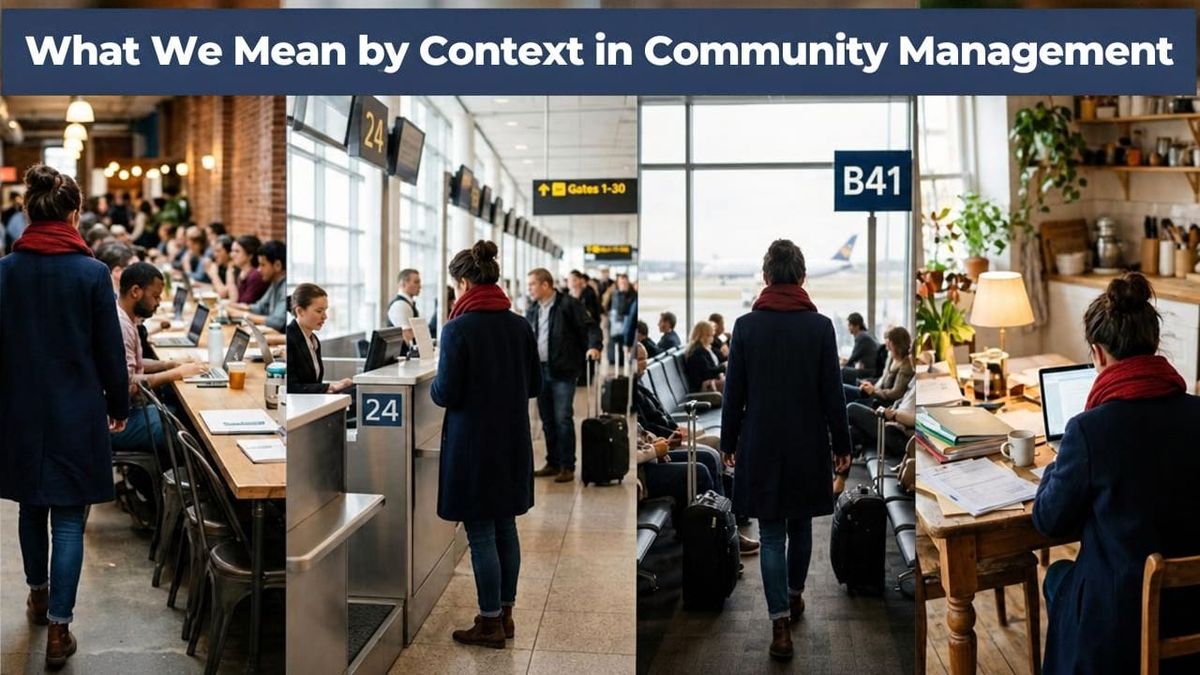
She posted in the community on a Tuesday, and she was patient about it. Two weeks later she emailed support, and by then she wasn’t. The sales systems had her as an account in good standing, renewal in ninety days, no flags. And somewhere in a call recording nobody had time to listen to, her CSM had promised her a fix by the end of the quarter.
Four systems, four records, four strangers who happened to be the same person. Chris’s point is that nobody inside the company failed. The community manager and the CSM didn’t miss anything, because none of it was theirs to see. They closed the ticket they were handed. They made the promise in good faith and logged it in a tool the rest of the company doesn’t open. Every fact was in the building. What was missing was the thing that would have made the facts mean something.
What context actually is
Before the definition, a news beat: the week of recording, Anthropic’s Dario Amodei published an essay calling on the industry to slow the pace of frontier AI development, days after one of his researchers resigned in public over the same worry. Marius reads it as the industry admitting it’s building faster than it can build safeguards. Chris reads it as a request to government from companies that won’t self-police and can’t afford to stop unilaterally. Neither expects the current administration to act. Both land in the same place: community managers don’t control any of that, but they do control their communities, and the work of this show is making the assistant an assistant rather than the thing running their shared space.
Before the definition of context, Chris starts with the three C’s of the early web — content, commerce, community — and the argument he was making back then: everyone said content is king, and he was saying that context is king. His example is a Sea-Doo homepage built for Bombardier with separate paths for the adventurer, the racer, and the family, so the same information arrived inside a story each visitor could recognize. Marius adds that marketing has always had this under other names. Personalization and personas are just ways of describing context — a badly written article for the right person beats the best article for someone who doesn’t care.
Chris brings in a less familiar word, situatedness: the nature of your situation and where you sit inside it, everything around you that adds up to the whole. And he flags the challenge with how the AI world uses the term now. Context engineering, as it’s usually practiced, treats context as a package, a bundle of data. That misses the root of the word, which comes from the Latin contexere: con, together, and texere, to weave. Context is not the stuff being gathered. It’s the weaving of the stuff that makes meaning and frames all that follows.
The context engineer
Marius’s response is the line that opens the episode’s second half, at 09:35:
“I’ve been a context engineer for 20-something years. I think as a community manager, that is what communities are.”
Think about what a community manager actually does when a community is built. Which groups should exist. What to call them. Whether to organize by product, by skill, or by some other attribute people share. The goal has always been to connect people, and you connect people by finding the attributes that match their common situation. That is context engineering, and it started the moment anyone becomes a community manager.
Chris takes it further: one of the community manager’s main roles is to weave the community together — the fabric, the tapestry — and he remembers someone who carried “community weaver” as a title. Marius offers the first practical use of AI in the episode: let it look at your community’s structure and surface the interest groups you never created, the topics people keep discussing that have no home yet.
AI makes context affordable
This is one of the show’s core theses, and Chris states it plainly. The tool is called an assistant because it assists. AI won't improve the relationship. What it does is make the ability to improve the relationship — by weaving this context together to present solutions to the members — more affordable. Take that mindset in, and you get more out of every tool you touch.
The Palm example Chris shared makes it concrete. Working on the Palm economy, Chris found one individual who was a customer, a developer building their own apps, and a reseller — three hats, one person, and very hard to reach because each hat lived in a different system. So context was never the facets in the data. It was the weaving of them, and the community manager can now take on that weaving more easily than ever before.
Marius agrees it was always part of the job, but it was never at anyone’s fingertips. Everyone sits in a different department with different tools. The responsibility now is simpler to state: before you get into a conversation, understand where the person is coming from. A single prompt — before I answer this, tell me about this customer, their journey, and their current situation — can pull from the sales system, support, the CSM notes, and the call recordings, and the answer that follows is meaningful because you finally know who’s asking, where they are coming from, and where they want to be going.
Chris closes the loop: AI doesn’t improve the relationship. Context improves the relationship, and the human relationships in a community do the rest. AI lets you see those four people as one human instead of four views through four lenses.
The daily brief
Asked what sparked the episode, Chris points at Marius’s daily brief, and Marius walks through it. Every morning his team gets a brief on what’s current in the community, prioritized by what matters to him: which conversations are negative, which are contentious, and which need an answer immediately because the customer warrants it.
What matters is what happens before prioritization. The AI goes out and looks at the individual across every available data source. Two people report the same broken feature. One is a ten-million-dollar account, the other a hundred-thousand-dollar one, and as someone responsible for a business, Marius needs to know where the revenue is before he decides what to do first. Then it looks at whether this is a recurring frustration or a first mention, whether a ticket is already open and stalled, and who in the company has the expertise to fix it. So the reply isn’t “I’ll look into it.” It’s: I’ve contacted the engineer who owns this, a ticket is open, expect a fix in a couple of days.
Marius is candid that before his AI daily brief he wouldn’t have assembled any of that. He’d have searched Jira for a name, maybe the CRM, and stopped. Chris’s math: even doing it by hand takes thirty minutes to assemble your own context before you can make one call. That is the definition of unaffordable. Too many systems. Too much time. Too much money.
Aggregate, process, understand, act
Chris turns it into a systems-thinking frame, because that’s what he thinks community managers need to adopt. Think like an architect. The MCP server matters here — it’s how a community platform can make its data and conversations accessible to an AI, and the same is needed from the CRM and everything else, so the whole view can be queried, reported on daily, and watched for change. Marius adds that MCPs are becoming table stakes; he doesn’t expect any serious tool inside a company to lack one. The payoff runs both ways. As a customer, he’d rather the airline already know he’s stuck and have a flight ready than spend twenty minutes explaining.
The four steps, in Chris’s recap: aggregate the data; process it and get it normalized; understand it — with the AI layer building a richer picture from every source so you can grasp it quickly; and act on it. Build that inside your company, and your value and political capital go up.
Marius’s worked example is the liaison role. A technical question arrives, and nobody knows who should answer. So: find the people at your company who engage in the community, set up recorded calls, and ask each the same questions — name, title, product expertise, which questions they like answering and which they can’t. Ten interviews. Give the transcripts to the LLM, have it profile each person’s strengths, and now the daily brief can say this question is right up Dave’s alley, or message Jen directly. Marius built exactly this with Higher Logic because he didn’t know who the experts were, and it produced what he calls an expertise knowledge graph.
Access, not a data lake
Recalling the IBM BluePages — the internal social network that surfaced who knew what across a few hundred thousand people — leads Chris to the word he wants to stress: access. Many community managers assume they don’t have the power for any of this. But this isn’t a data migration or a data lake. It isn’t a golden record you can overwrite. It’s read access, aggregated by the assistant, so you can do the job you were hired for. That’s an easier case to make in most organizations, and it reduces the security exposure, though vendors still have to be vetted and security protocols followed closely.
Marius goes further: you don’t need any of it to start. If you can’t record that Zoom call, email your ten experts the four questions and build the foundational context for connecting community members with the right experts from their replies.
Held in trust
One reminder from Chris: tell people you’re recording, and tell them why. It’s the relationship. Last episode landed on trust as the cost of slop, and trust is the reason members hand a community their questions and their history in the first place, expecting the company to receive it as one company.
Which is where AT&T comes in. Chris recently spent nine hours across several calls and online chats trying to remove an erroneous charge, and every call began as if it were the first. On the last call, the support agent told him plainly: there was nothing he could do until it got escalated to collections. Who wants to do business with a company that large that can’t solve the most basic of customer billing issues? Too many companies still have systems designed to deliver that kind of terrible experience, just like AT&T. The systems described in this episode are designed to deliver the opposite: to let you show your customers you actually care about them as humans.
Three ways to act
Once context is assembled, Chris sees three ways it gets used.
Being prepared: the brief lands before you reply, the way sales teams now get an account summary the night before a meeting. Marius remembers teaching social selling, where reps did that research by hand on LinkedIn; AI does the same faster.
Being prompted: the assistant surfaces, alongside a new post, that this “new user” is from the ten-million-dollar account, has talked to the CSM, owns these products, and used to work at IBM — and the relationship opens from there.
Being drafted: the assistant writes the first draft. Both hosts put the brake on here. Don’t hit the easy button. Read it, put it in your own voice, check it isn’t bloated, off, or wrong before you send, as they explained in EP001 on AI slop and what it costs the community.
Monday
Chris admits to often boiling the ocean; the four-records-one-human future is the ideal state, not step one. Marius’s suggested whiteboard use is step one. List the data you’d want to aggregate — by type, not by tool. Under each, note where it lives. Circle what you can reach today. Put everything else in a second bucket for tomorrow. Process the first bucket with your LLM, then make it actionable. Earn the second bucket by showing value to the rest of the company.
His smallest, best example: the single change that most improved suggested replies in his community was telling the LLM where the documentation lives. Now every incoming question gets checked against the docs, and the suggested answer arrives with the link. He reads it as a human, adjusts, and posts.
Chris ties it back to building your own personal intelligence system — everything you’ve written, read, and engaged with, so the assistant serves you better — with the standing caveat: the point is to be more human in your customer relationships, not to give up your humanity.
What’s ahead
Next week gets more tactical with a deeper dive into the Daily Brief and the specific tools and processes practitioners are using to build it, and the question Marius wants argued — should you use every AI, pick one per use case, or master one? Chris’s preview: if they only give you Claude, use Claude. If they only give you GPT, use GPT. Don’t worry about the others.
See you next week.