Your knowledge is your asset
At Bill Johnston's Structure.Community Fall Summit, I asked a room of community leaders to treat what they know as something they own. Here's the talk, the story behind it, and three things you can do this week.

Last Friday I spent the day at TechSoup in San Francisco, helping my friend Bill Johnston facilitate the Structure.Community Fall Summit. Bill runs Structure3C, where he helps enterprise companies build customer communities and partner ecosystems.
Bill gave me a few minutes to share some insights on AI, the future of work, and the future of community manager careers. You can listen to what I shared in the YouTube video below. With thanks to our sponsor Higher Logic.
Something you think of as abstract
Evan Hamilton had just made the point that the human work we do is getting more valuable, not less. The open question for most is the work that lies between fully automated and fully human. That gray area is what we're working through on this show, and it's what everyone in that room was working through too.
So I asked them to protect what is uniquely theirs. That starts with seeing your knowledge and experience as an asset.
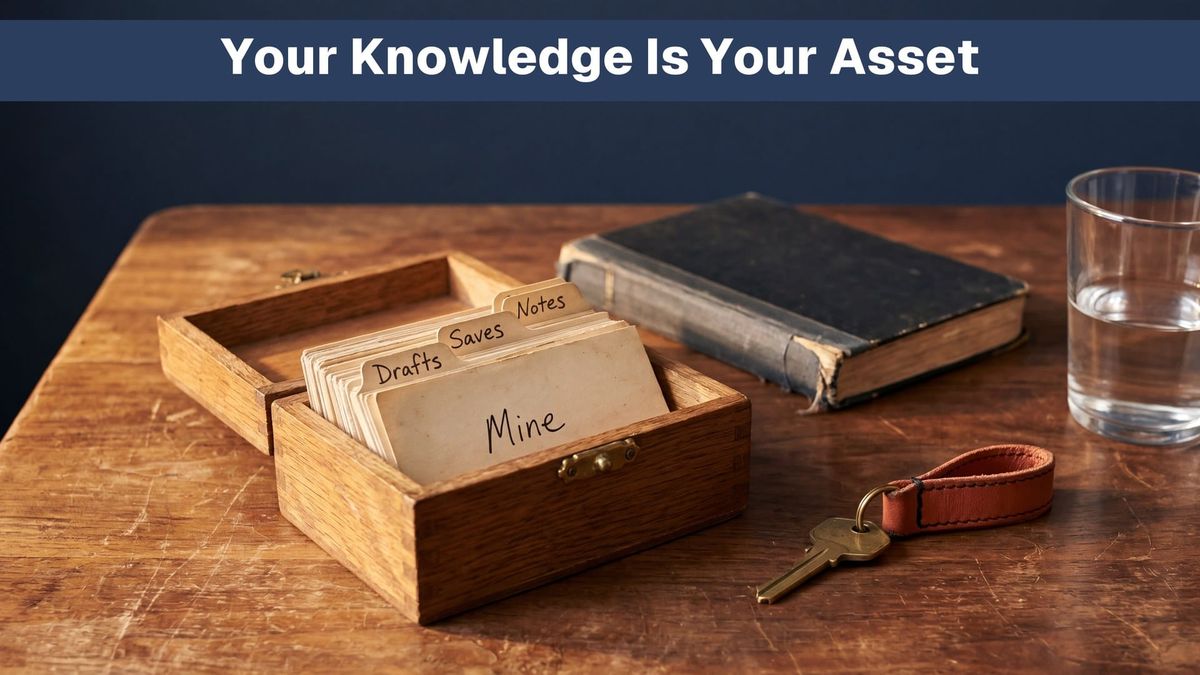
Most of us think about what we know in an abstract way. But curating what you know, what you write, what you read, and what you pay attention to, and building it into something you keep, whether you call it a second brain or a vault, is building a financial asset. Owning it on your own computer and your own devices, instead of handing it all to a platform, will matter more and more as your career goes on.
Here's the part that got the room quiet. If you work at a big company, your employment agreement very likely says that everything you produce inside its digital workspace belongs to the company. All of it. In principle they could take that material, spin up a digital twin of you, and let you go.
They wouldn't get your humanity, your judgment or your wisdom. But they don't necessarily need you unless you bring some other unique value.
Personal intelligence, licensed back
My vision is something I call a personal intelligence system. It's your intelligence, held in files you own, in a form you control.
If you get laid off or move on, you could license it back to your employer, and if they keep using it, they keep paying you. Residual income for what you know and what you have curated. Or you put it into a marketplace. Instead of Upwork, think of something like "TwinWork," where someone hires your digital twin for a certain level of work, with everything you know and how you think. And when they need higher accuracy or judgment, that becomes the gateway to hiring you.
None of that works until employment agreements change so we get to keep some of our own knowledge and turn it into an asset. It also doesn't work unless you've started building the thing. Which is just one of the things you will get from my upcoming book "Conversations With My AI" and from this new software I am using to work with my Claude called The-AIOS.
What's been on your backlog?
You've probably heard the term "harnesses." There are several systems out there now. I recently started using one that finally fits what I'd imagined, the AIOS. Within about an hour I had six agents running on work that had been on my backlog for close to ten years.
One example: I've owned NetTrustScore.com for years, back from when I was thinking past Net Promoter in 2000 or so. Last month I built the whole site, with the application logic, submissions and sign-in, in under five hours. Only 45 minutes of that time was at the keyboard and 20 minutes on my phone.
Another: I sent an agent to retrieve everything I'd saved on LinkedIn over the years, the bookmarks and the articles. It downloaded and organized all of it onto my own hard drive. Now when I write about a topic, I can say, "Look through everything I've saved, including my Instagram saves, and find citations that support or challenge my thinking." That library used to be scattered across platforms. Now it's mine.
So, honestly: this much power is going to be hard on the economy. There will be more pain in the short term than any of us want, and regulation isn't close to keeping up. The people who come through it best will be the ones who prepared, building assets, skills and experience that hold value whichever way this goes.
A small paradox worth holding
Earlier in the day, I'd talked about the mindset we bring to working with AI, which is what my book, Conversations With My AI, is about. I asked the room how many of them say thank you to their AI. Most hands went up. Mine too.
I've seen research suggesting it doesn't improve the answers, and every extra word costs energy and water. I think it's worth it anyway, because the habit is for us. Being polite and kind reinforces how we treat each other. A specific thank you, "the way you handled this part was exactly right," also tells the agent what to keep doing.
The same goes for naming agents. One of mine is called Sam. It isn't a person, and there's a slippery slope in pretending otherwise. The name is for me, so I know where the work is and who I sent it to. Holding both of those at once, it's not human and I still treat it with care, is part of the job now.
Three things to do this week
- Start a folder you own. Pick one place on your own device. Export something you've built up over time into it: your saves, your notes, your best posts.
- Read the IP section of your employment agreement. Know what you've already signed away, before you need to.
- Pick one backlog item and hand it to an agent. Something you've wanted for years and never had the time for. See how far it gets in an afternoon.
Thank you to Bill for the invitation and for building a room where people actually show their work. And thank you to my co-host Marius, CCO of Higher Logic, who saw early on that this show should serve the whole profession, not just one company. That's why we invite every vendor and platform onto it.
What's been sitting on your backlog that you could do now? Hit reply and tell me. I read every one.