Slop Is in the Eye of the Beholder
What AI slop actually is, why we can smell it, and who gets to decide.

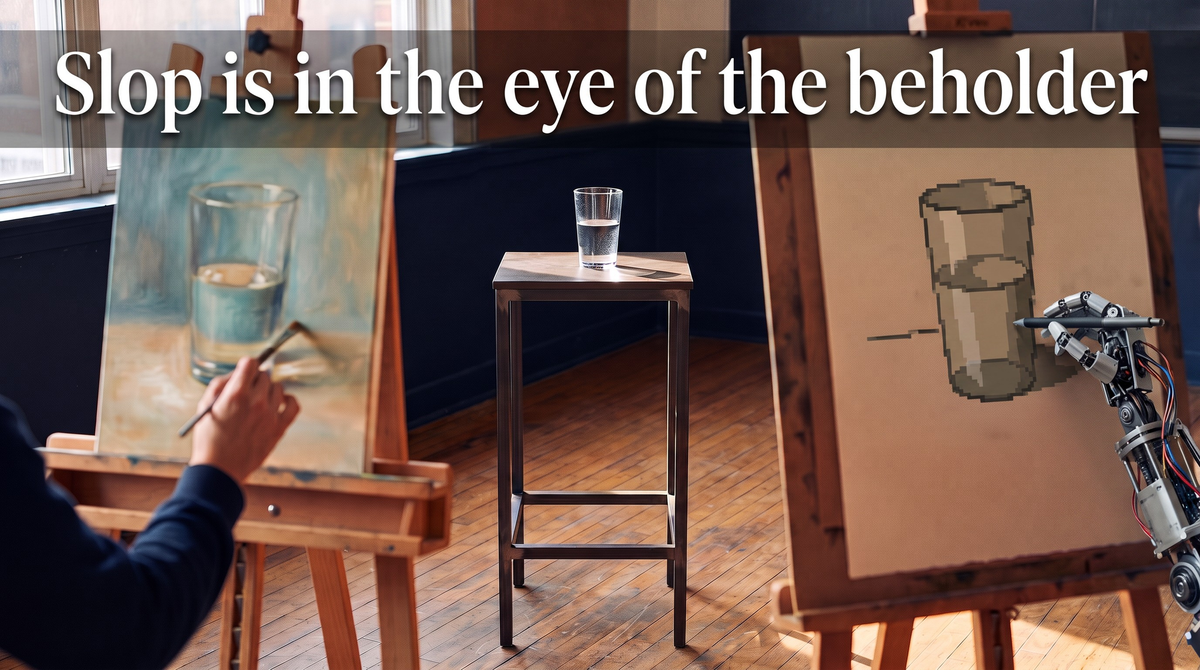
What is AI slop, exactly? Why can people seem to sense it in half a second of scrolling? And if it's so obvious, why can't any two people agree on a definition?
The title of this column came out of a conversation with my co-host Marius Ciortea. We were talking about audience reactions to AI-assisted content, and the old adage surfaced on its own: beauty is in the eye of the beholder. Well. So is slop. And I mean that seriously, not as a dodge. The more I dug into what people actually mean when they say the word, the more I realized we are living out the parable of the blind men and the elephant. Everyone has a hand on a different part of the animal, everyone is certain, and everyone is describing something real. To them. They just aren't describing the same thing.
The word itself has already won. In 2025, "slop" was named word of the year by Merriam-Webster, the American Dialect Society, The Economist, and Australia's Macquarie Dictionary. Four institutions that agree on almost nothing, agreeing that we needed a name for low-quality, high-volume, machine-generated content. The framing most people trace it to is Simon Willison's, from May of 2024: slop is to AI what spam is to email. Not all AI content, he was careful to say, the mindlessly generated kind, pushed at people who never asked for it, with no human standing behind it. That last part matters more than you might think, and we'll come back to it.
Three beholders, one word
Ask three people what AI slop is and watch them describe three different animals.
One points at the image of a hand with seven fingers. For her, slop is the machine's errors showing. The mangled anatomy, the invented citation, the confidently wrong fact. Another points at the prose -- the delves, the tapestries, the tidy "it's not just X, it's Y" pivots arriving in bulk — for him, slop is the pattern, the literary devices worn smooth from overuse. A third doesn't need to look at the content at all: if AI touched it, it's slop, the way a forged painting is a forgery no matter how good the brushwork.
Three beholders, three definitions, one word. Widen the survey and you find at least two more hands on the elephant: the people for whom slop means bloat. Long, fancy-sounding, formatted-to-death documents that say nothing, the workplace version of which now has its own name, workslop, which researchers at BetterUp and Stanford found roughly two of every five desk workers had received in the past month, each incident costing its recipient nearly two hours to untangle. Then there are the people for whom slop means the voice of nobody, that smooth, professionally beige register that reads like the statistical average of all writing because, as we covered in Measure Twice, Prompt Once, that's more or less what it is.
And here's the twist worth sitting with: the first two beholders, the error-spotter and the pattern-spotter, are describing the same underlying failure from different sides of the elephant — as are the bloat and beige camps. It's only the third beholder who's describing something else entirely. Not a quality judgment. A provenance judgment.
A Pollock walks into a salon
A few weeks ago I sat in a room in San Francisco full of technologists, artists, philosophers, and educators, at a salon on exactly this topic hosted by Tess Posner's nonprofit Resonance. Part of the evening was an art critique exercise: different works on the table, and the question, which of these is slop?
One participant looked at a Jackson Pollock and called it slop. Honestly, plenty of people would agree; people have been saying some version of "my kid could paint that" since 1948. But when I pushed back gently, told him he was entitled to that opinion, something more interesting happened. He hesitated. He questioned whether he was allowed to hold that opinion, given that the experts, the museums, the market, the whole apparatus of taste had long ago ruled Pollock a master. His eye said one thing. The institution of beholding said another. And in that hesitation, the whole evening's question answered itself: the judgment was never only in the object. It lives in the beholder, in their experience, their perspective, their feelings, and their relationship to the authorities they trust to see for them.
Now run the same dynamic on AI content, and notice how much of the judgment depends on what the beholder brings to it. If you don't know the subject matter, a piece can be convincingly fluent and still be technically or factually wrong. You'd never catch it, and to your eye it isn't slop at all. If you're steeped in AI-written text, you'll spot the borrowed devices — the em dash deployed just so, the think-of-X-as-the-Y-of-Z comparison, the paragraph that lands on a tidy triad — where a reader who's never noticed the patterns sees only competent prose. And if the writing is grammatically shaky, logically loose, or reaching for words whose context it doesn't quite grasp, some readers will wince while others sail past. Same content. Different eyes. Different verdicts. The elephant hasn't moved; the hands have. The brains which are processing what the hands, and eyes perceive.
The elephant stands somewhere: context
And all of those eyes behold from somewhere, which may matter more than any characteristic of the content itself. The same generated image is a joke in a group chat and slop in your news feed. The same two thousand words are an essay when you sought them out and bloat when they interrupted you. Even Willison's original definition smuggled this in without most people noticing: the offense wasn't just that the content was mindlessly generated, it was that it was thrust upon someone who never asked. Unrequested-ness is placement. Slop, at its core, may be content put where it wasn't invited, at a length the invitation never covered.
Which quietly implicates the platforms as much as the prompters. Feeds that reward volume will get volume; attention markets that pay for filler will be paid in filler. There is a much bigger column to write about what that means for culture and media, and what it's doing to the commons we all swim in. Another day. For now, hold the thought: the beholder's eye always beholds from somewhere.
The gray in every gray area
So take the beholders' definitions in turn, and honestly. Because every one of those judgments carries a gray area, and pretending otherwise is its own kind of sloppiness.
Facts. The clearest case. Wrong is wrong. But humans publish confident nonsense too, and always have; nobody called it slop when a rushed blogger did it in 2009. The judgment is real, the double standard is also real.
Voice. Homogenization is measurable. A study in Science Advances found AI-assisted stories rated more creative individually while becoming measurably more similar to each other. But "generic" is a judgment about deviation from a norm, and norms vary. One reader's beige is another reader's clean.
Tells. This is the grayest zone of all, and it comes with a story of virality, and even t-shirts, that I still celebrate. My friend Ann Handley, Wall Street Journal bestselling author, the world's first Chief Content Officer, one of the most respected writing teachers alive, spent late 2025 mounting a public campaign called Justice for the Em Dash, merch line and charity fundraiser included, because the internet had convinced itself that a piece of punctuation in continuous use for roughly four hundred years was a machine fingerprint. As she pointed out, people were patrolling LinkedIn like a grammar crime unit, accusing human writers of being robots, and the models only overuse the em dash because we do; they learned it from us. When the beholder's eye can look at Ann Handley's writing and see a machine, the eye is broken, not the writing. And it gets worse than punctuation: the automated detectors built to catch AI text have been shown to flag non-native English speakers at alarming rates. One study found more than half of a set of non-native essays misclassified as machine-generated, because simpler, more regular prose looks statistically "AI." Read that again. The tools we built to detect slop are accusing humans of being machines for the crime of learning English as a second language. (Despite Ann fighting for them, I must admit to rewriting it regularly out of my AI production text to ensure my own voice is heard and not dismissed.)
Bloat. Too long is a real failure. It's also genre-relative and, as we just established, context-relative. This column is well over two thousand words; to a LinkedIn-native reader, that's bloat. To an essayist who chose to be here, it's a warm-up.
Provenance. Here's the finding that should unsettle everyone: in study after study, labeling identical content as AI-generated lowers how accurate, credible, and creative people judge it to be. The words don't change, only the label does. In one experiment, readers couldn't reliably distinguish AI poetry from human poetry, even slightly preferred the AI's. Until they were told which was which, at which point the human preference snapped into place. That's not quality detection. That's prejudice wearing quality's clothes. And I say that as someone who deeply respects the impulse underneath it, because what those readers are actually defending is something worth defending: the presence of a person behind the words.
So yes. Slop is in the eye of the beholder — partially, meaningfully, measurably. And also: not entirely. Which brings me to my own definition.
My take: three characteristics, one cause
After sitting with all of this, here's where I've landed. Content is slop when it fails on some combination of three characteristics:
It's wrong. The facts don't check out, the sources don't exist, the claims don't survive contact with reality.
It's bloated. It takes three times the words its ideas deserve, and it makes the reader do the compression the writer skipped.
It's off. The grammar, word choice, and rhythm are visibly machine-default. The AI equivalent of a typo or the wrong word choice, evidence that no human read it on the way out the door.
Notice that the error-spotter and the pattern-spotter from our opening are both inside this test — wrong and off, two hands on the same failure. And notice what's not on my list: whether AI touched it. Because every one of those three failures has the same root cause, and it isn't the model.
It's us. It's laziness. It's using AI as an easy button instead of as a tool in a process. The technical account backs this up: what makes default model output generic is well studied. Training tuned toward the familiar and typical, and above all, under-specified requests that leave the machine no option but to serve the average. Give it nothing and it gives you the mode. The slop was never really generated. It was permitted. Invited even.
Owning mine
And now I have to hold my own work up to that light, because I would be a fraud not to.
The Work Map — the library of nearly three hundred community management jobs at the heart of this project — has slop in it. I know because I've spot-checked it and found some. There are passages I can see the machine's defaults in, jobs where the research didn't get the hundreds of human hours a canonical reference deserves, because I am one person and those hours did not exist. By my own three-part test, parts of it are off, and until proven otherwise, some of it may be wrong. I'm telling you this before a critic does, because working out loud means showing the flaws too, not just the highlight reel.
But here's what I've noticed about owning it, and it changed how I think about imperfection in open work. Persian rug weavers are said to have woven a deliberate flaw into every carpet, a humility about perfection belonging elsewhere. And the internet has long known a scrappier version of the same truth. The observation, often credited to Ward Cunningham of wiki fame, that the fastest way to get the right answer online is to post the wrong one. A visible flaw in a shared artifact isn't only a failure. It's an invitation. Every wrong detail someone catches in the Work Map is a person who cared enough to look closely, and every correction makes the canon stronger than polish ever would have. Which is why the whole system is built with a revision trail, so no fix happens silently. The difference between slop and a work in progress is whether anyone is standing behind it, taking the corrections, and doing the work. Unowned flaws are slop. Owned flaws are how communities build things.
As with our own pilot episode. We gave it the wrong context for a fact. Found out it was misquoted slightly. Owned the mistake, took it as a lesson. Redid everything it affected, a hefty price. Then we shared how it happened and how to avoid it happening to others. As I’ve long said on stages, in board rooms, and in community -- its not so much that you make a mistake, it’s what you do about it afterward.
The power of naming things
There's an old idea, told most beautifully by Ursula K. Le Guin, that the greatest power in the world is the true naming of things. In her “Earthsea”, to know a thing's true name is to have power over it. Four dictionaries crowning "slop" in a single year was a mass act of naming, and the power arrived on schedule: the word now shapes what we see before we've looked. That power comes with a responsibility, because a name this strong gets applied to things it doesn't truly fit. Ask Ann. Ask the Pollock skeptic, unsure whether his own eye and judgment was allowed.
Which brings us to art. All art is a conveyance of something its maker perceived as valuable — a truth, carried from one mind toward another. The absolutists who say AI output can never be art, only slop, are not being snobs. They are making a claim about what art is: that the conveyance requires a human on the sending end who lived something worth conveying. I don't fully share the absolutism. I've watched people use these tools to finally get something out of their heads that had been trapped there for years. But I refuse to dismiss it either, because it's guarding the right treasure. The question was never whether the machine can arrange pixels or words. It's whether anyone was intentionally expressing something through them.
What the Luddites actually wanted
I want to close with a piece of history that almost everyone gets backwards, because it's ours now.
The Luddites — the original machine-breakers of 1811 — were not anti-technology. They were skilled textile workers, and the record shows they aimed their hammers selectively: at manufacturers using machines, in the movement's own words, in "a fraudulent and deceitful manner" — cranking out inferior goods and passing them off as the real thing, undercutting the craftspeople who knew the difference. They didn't hate the machines. They hated the anti-human slop. They wanted machines to be tools, operated by trained hands producing quality work, and they were willing to fight for that standard. (Brian Merchant's Blood in the Machine tells this story properly, and it reads like it was written about this decade because, in a sense, it was.)
Two hundred years later, I'm not suggesting we pick up hammers. I'm suggesting we do what the Luddites were actually asking for: insist that the machines be run by people who know the craft, to a standard the craft can be proud of. Sometimes that means deliberately interrupting the machine's momentum. Refusing the first output, throwing the proverbial stick into the loom, forcing the process to slow down enough for judgment to catch up. That pause is not inefficiency. That pause is the craft. That pause should be the new requirement, easy button notwithstanding.
So here's where I'll leave it, and where I hope you'll pick it up. Journalism has its AI standards now. The academic publishers have theirs. Community management, a profession built entirely on trust, doesn't yet have a shared standard for how we use these tools with our members, and we should be embarrassed to let anyone else write it for us. Everything published on this site carries the disclosure "Made with Claude, not by it," I hold everything that ships to the test below, and I own the flaws you find. That's my standard, version one, offered in the open.
Because the point was never to defend the machines or to condemn them. The point is intentionality: deciding what we value, naming it truly, and knowing why we believe what we believe — going beyond the belief to the reasons underneath.
What's yours? What makes something slop to your eye — and where's your gray? Tell me, and let's write the profession's standard together, the way communities always have. I am better off when you are better off.
Measure twice. Prompt once. And never let the machine ship without you.
The Tangible: The Slop Test — Five Conditions of Slop
In Measure Twice, Prompt Once, I gave you Conditions of Satisfaction — how to define what done looks like before you prompt. Here's the practical approach for “Conditions of Slop”. Run any piece of content, yours or anyone's, through these five. Each has a test, and each has a gray zone where honest people will disagree. Knowing where the gray is is the skill.
- Wrong — Would every factual claim survive a spot-check? Gray: humans publish errors too, and simplification isn't falsehood.
- Bloated — Could it say the same thing in half the words without losing anything? Gray: length is genre- and context-relative; an essay isn't a caption.
- Off — Does any sentence read like nobody chose it? Gray: the tells are unreliable — ask Ann Handley, ask every non-native English writer falsely flagged by a detector.
- Uninvited — Was it placed where the audience asked for it, at a length the invitation covered? Gray: platform norms shift, and feeds blur what "invited" even means.
- Unowned — Is a named human standing behind it, taking corrections and responsibility? This is the least gray of the five. Content can survive being a little wrong, a little long, a little off — if someone owns it. Nothing survives being unowned.
One or more conditions failing? It's slop, whoever made it — or whatever made it. Zero conditions failing and someone still calls it slop? Then you've just learned something about the beholder.
Copy it, adapt it, make it yours — and bring your version back here so we can sharpen it together.
Check out this week's podcast on "What Is AI Slop and What Does Slop Cost a Community?"
Sources & further reading
- Simon Willison — Slop is the new name for unwanted AI-generated content (May 2024)
- American Dialect Society — 2025 Word of the Year · Macquarie Dictionary via The Conversation
- Ann Handley — The Em Dash Is NOT an AI Tell: Justice for the Em Dash!, Total Annarchy (Nov 2025)
- Kobak et al. — Delving into LLM-assisted writing in biomedical publications, Science Advances (2025)
- Niederhoffer, Kellerman, Lee & Liebscher — AI-Generated "Workslop" Is Destroying Productivity, Harvard Business Review / BetterUp Labs × Stanford Social Media Lab (Sept 2025)
- Doshi & Hauser — Generative AI enhances individual creativity but reduces the collective diversity of novel content, Science Advances (2024)
- Liang, Yuksekgonul, Mao, Wu & Zou — GPT detectors are biased against non-native English writers, Patterns (2023)
- Porter & Machery — AI-generated poetry is indistinguishable from human-written poetry and is rated more favorably, Scientific Reports (2024)
- Zhang et al. — Verbalized Sampling: How to Mitigate Mode Collapse and Unlock LLM Diversity (2025, preprint)
- Ursula K. Le Guin — A Wizard of Earthsea (1968), on true names
- Brian Merchant — Blood in the Machine: The Origins of the Rebellion Against Big Tech (Little, Brown, 2023) · Smithsonian Magazine on the Luddites' actual grievances
- Resonance — salon on AI slop, SF Commons, Aug 2026