Why GEO Belongs to the Community Team
Generative Engine Optimization is a real job with a real budget line coming. In most organizations nobody has claimed it yet. Here is the case that it should be you.

Subscribe on your favorite podcast network
Apple Podcasts · YouTube · Spotify · Amazon Music · iHeartRadio · Deezer
There is a job being created right now in most organizations, and in many of them, nobody has put their hand up to own it yet.
The job is generative engine optimization. GEO. Also known as Answer Engine Optimization. AEO. It is the practice of making your content the thing an AI system cites when a person asks it a question, which is increasingly the only moment that matters. When an AI chooses what is visible to the world and what is not.
For twenty years, the closest equivalent job was SEO, and SEO lived in marketing. That made sense. Marketing owned the pages, the keywords, the site architecture. The work was mostly about how a document was constructed. Where the terms sat, how the headings nested, what linked to what.
GEO is not that job wearing a new name. AI is doing more than counting keywords. It evaluates whether an answer is likely to be correct, then decides whether to risk its credibility by saying it is the answer and trying to make you happy. Those are different approaches, and they produce different results.
Which brings me to the line from Marius Ciortea during this episode that sums up the opportunity:
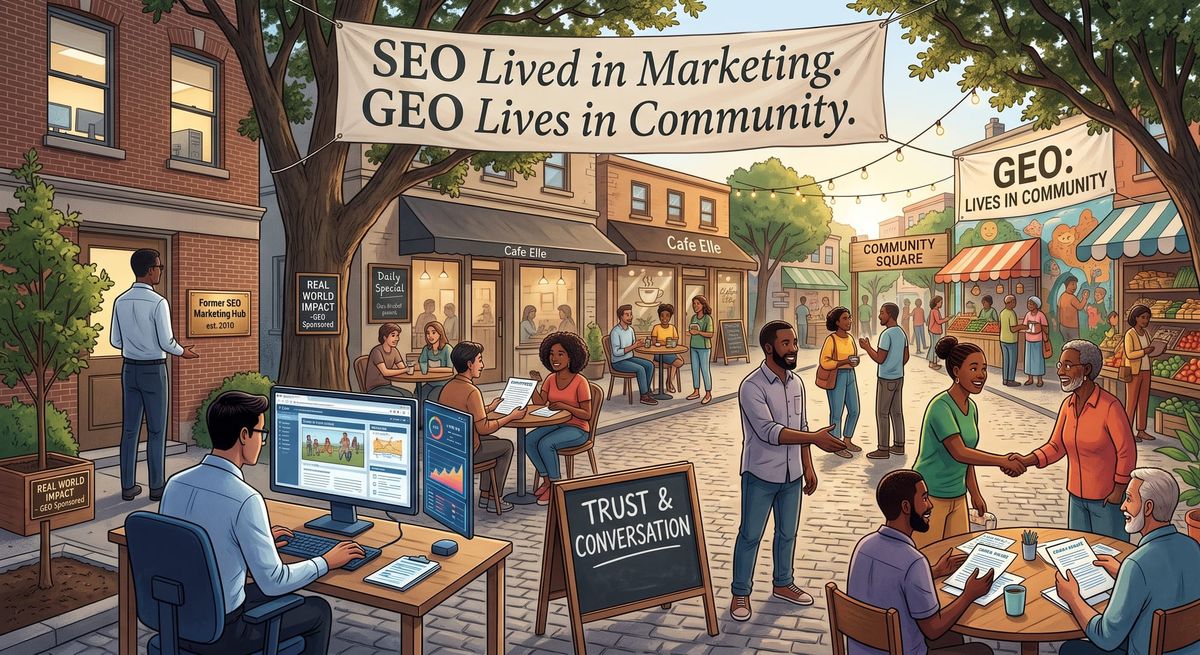
"So I think that as SEO lived in marketing teams, GEO specialists will live as a part of a community team, or adjacent to a community team."
In my view, this is now a structural argument about who owns the asset.
The ownership argument
Ask what content a brand actually has, and you get three piles.
The first is marketing copy. The company wrote it about itself. Models discount it for exactly the same reason you would: the author has an obvious interest in the answer.
The second is social. That one is user-generated, which is better, and it does get cited. But it comes from people the brand cannot vouch for and does not control. You can influence your social strategy. You cannot tell an AI system anything meaningful about who those people are or why their answer should be believed and why another one should be ignored.
The third is your community. And the community is the only pile that is both genuinely user-generated and fully known to you. You know who those people are. You know which of them have been right for six years running. You know which answers your own support team blessed. You can attach that knowledge to the content.
That is the whole argument, and it is not sentimental. The person who owns the only credible, attributable, influenceable corpus in the building is the person who should own the practice of making it legible to machines. In most companies, that person's title says community.
Why this is urgent rather than interesting
Because the metric you have been reporting is dying.
For a decade, the community business case was driven by page views and visitors. Then on engagement more broadly. When traffic went up, you had an investment and ROI story. That story is coming apart from two directions at once. First, more of the requests on the web now come from crawlers than from people, at least according to the metrics Cloudflare publishes.
The second direction is the one you can feel. The member who used to land on your forum with a question is instead asking an assistant (or Google AI Overview), getting a clean answer in under thirty seconds, and never arriving. I did this myself while we were recording the pilot episode. We hit a setup problem, and instead of going to the product's own community, I asked Claude and got a working answer before I finished reading the forum's taxonomy. That company never saw the question, never saw the resolution, and never counted me as a visitor.
Marius put the consequence more bluntly than I would have: if traffic is the only way you justify your existence, you are already in trouble.
He is right, and I would add the part that makes it survivable. The traffic was never the value. It was the evidence of the value, and it happened to be easy to count. What is actually being taken away is your proxy, not your worth. GEO is where the new evidence comes from, because citation data and bot-versus-human traffic are already appearing in platform backends. You will be able to show that the answer came from your community, but the direct line is not so clear. That can be a better number than page views ever was, because it is closer to what you were actually doing.
What the work actually is
Here is the part that surprised me, and it is the reason I think this is a promotion rather than a disruption.
It is not merely a technical project. There is a lot of noise right now about llms.txt, markdown mirrors, and new ontology files. Marius's prediction, which I share, is that most of that will not decide anything. The models are already good enough to read your pages. They are not confused about your HTML.
What they cannot do is guess at standing. And standing is the thing you already have and have never had a reason to expose.
Five signals do most of the work, and they answer two questions.
Who says so. Is the person who answered recognized by the community as having authority in that area, and is that recognition visible rather than folklore? Is the answer from a company employee? Is it from support specifically? Did other members endorse it?
Does it still hold? Was the answer marked correct? Is the content current, or is your community quietly serving five-year-old answers about a product that has changed twice since?
Read that list again and notice what it is not. There is nothing in it you would not want to be doing anyway. Recognizing your best contributors, marking correct answers, retiring stale threads. This is community management. It has always been community management. The only thing that changed is that doing it well now has a machine-readable payoff, and a budget line to point at.
Your community already has the answers. What it has been missing is a way to show the machine who is standing behind them.
The part I have to own
I built the Work Map as an inventory of what the job of a community manager working with an AI assistant actually consists of, stage by stage, community type by community type, with every job marked as human work, agent work, or shared.
GEO is not in it.
Between when I started building that map and when Marius and I sat down to record, an entire discipline showed up that the map does not account for. That is a gap, and I would rather say so here than have you find it. We are going to add it, in public, and I would like the people who are actually doing this work to tell me where I get it wrong.
Because the thing about a job nobody has claimed yet is that the definition is still up for grabs. Somebody is going to write it. It should be the people who already own the asset.
Come tell me what I am missing.
Listen to the episode, check out the show notes, or read the transcript — SEO Lived in Marketing. GEO Lives in Community.
Explore the Work Map — communityassistant.ai/work-map
CommunityAssistant.ai is the podcast and open resource library exploring the human work of community management: what AI can take off your plate, what only you can do, and how to grow into the role that's coming. Hosted by Chris Heuer and Marius Ciortea.
Sponsors
Community Assistant is made possible by Higher Logic, supporting the practitioners who build the communities that matter, and Inflection Point, a modern collective of digital guides for this critical moment in history.
Independence
Sponsors make this show possible. They don't make this show. Marius works at Higher Logic; he appears here as a practitioner speaking for himself, not for his employer.
Disclosure
Made with Claude, not by it. Published under CC BY-NC 4.0.