Your Third Brain is You, And So Much More
Jack Myers' new book, Your Third Brain, argues that the third brain isn't the AI. It's us, thinking co-intelligently with machines. Over two episodes of the podcast, Jack and I talked about what that asks of us and spending what AI gives back on each other.

A few months ago I was working on a project with a couple of guys who would regularly send me 8,000-word documents their AI had produced. They preferred that I process those rather than talk with me for 30 minutes.
That's faster and more convenient, but it wasn't making us stronger, improving alignment, or building momentum. Nobody understood each other better at the end of it, and nobody grew.
The third brain is a new you
Jack's book is based on the existence of three proverbial brains. The first is biological, "the one we were born with, the one that we use to learn." The second is our "cultural brain, our social brain, our connected brain to the rest of the world." And "the third brain is co-intelligent with machines."
It's easy to hear that and think the AI is the third brain. Jack is clear that it isn't. He calls it "techno intelligence versus artificial intelligence," intelligence that is "expanding, amplifying, and growing our intelligence." And he gives it a job: "the third brain's job is to strengthen the first brain and the second brain and make them more intelligent and make them more capable and grow."
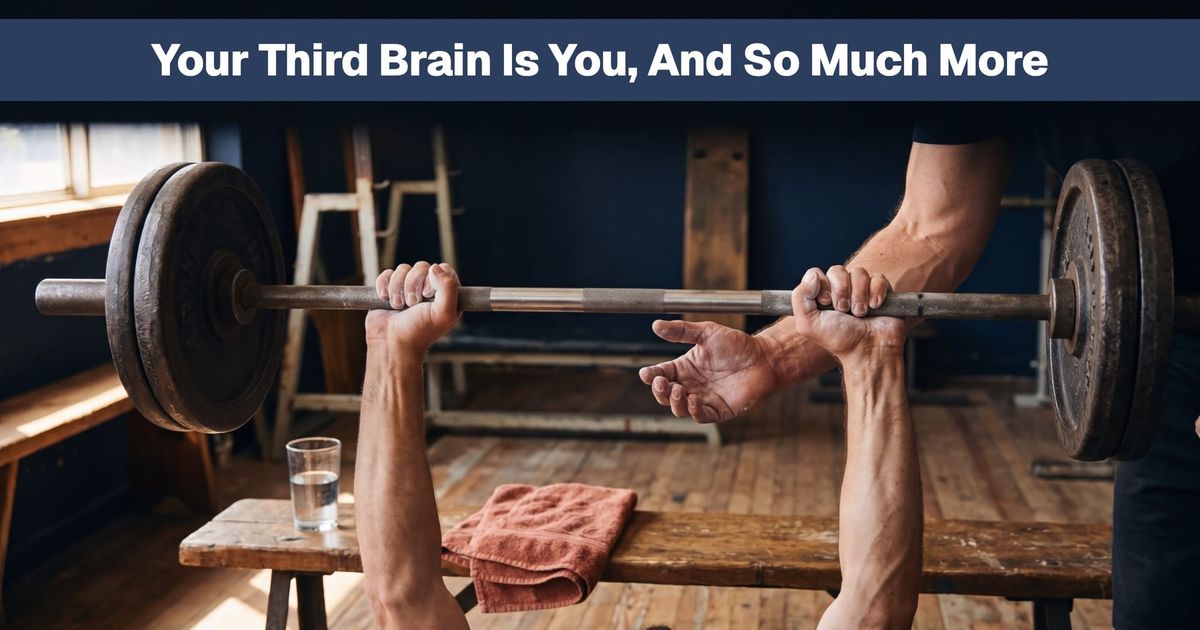
Think of a spotter at the gym. The spotter's hands are right there under the bar, and they never take the weight. You get stronger because you're still the one lifting. That's why I keep coming back to one word: the third brain is something you develop. Done consciously, it's a positive evolution. Done without thinking, you lean on it until you forget how to stand. Done with the easy button mindset, you've already lost.
Jack's book is built to help you unlock this evolved version of you, this state of co-intelligence with AI. In Part 2 we discuss how every chapter begins and ends with stories of how people will be "empowered, enhanced" in a world with AI, so the ideas manifest in "our own day-to-day lives."
Every company has an AI strategy
Jack asked the right question in Part 1: "Every company today, every corporation, every educational institution has an AI strategy... But how many have a human strategy?"
I've seen the gap for 30+ years dealing with enterprise IT. We fund the technology and underfund the people who have to change with it. At the Team Flow Institute we wrote about how to prepare for the integration of AI to achieve business and human success: AI belongs inside a broader transformation, with the training, skill development and change management the people side needs. Jack wants that plan to serve "the human change that's happening," for the people AI empowers and for the people it displaces.
He took a metaphor I'd used, the valve a worker gets told to open to dump chemicals in the river, and turned it around. There's another valve, he said, closed for a hundred years: "the flow of ethics, of integrity, of judgment and discernment, of purpose, of meaning, of humans feeling and creating a sense of belonging for each other."
Creating belonging for each other is a community manager's work. If your organization has an AI strategy and no human strategy, you may be the person best placed to write the first draft. Start with your own third brain. Subscribe to my newsletter on Linkedin for learning how to work with your new thought partner.
Three capacities to develop
In his newsletter, Jack names the third brain's core capacities: discernment, integration, and accountability. Each one came up in our conversation.
1. Discernment: ask for choices, not a verdict. Jack's biggest worry is that "we cede the responsibility or the right to make decisions, to make choices to the machine." His alternative is to have the AI lay out the options and keep the choice: "give me my choices, but then ultimately the human capability is the ability to make your own choices and bring your own judgment." He applies it to the hard moments too: "my boss is asking me to do this, and I think it's wrong... Give me my options."
Try this: when a thread heats up or a member complaint lands, don't ask your AI for the reply. Ask for three ways to respond and what each one risks. Then pause, pick one, and write it in your own words.
2. Integration: your archive has no judgment. When I asked about the "second brain," the vault of notes and files many of us keep now, Jack said that's really first-brain work, stored. It becomes a third brain when it becomes "your collaborator, your partner," and "that vault doesn't by in and of itself have judgment." Your community has a vault too: years of threads, the knowledge base, event notes, what members have told you.
Try this: before your next member call, have the AI pull together what that member has said and asked over the past year. Then bring what the archive can't: your read on the person, what they need now, and who they should meet.
3. Accountability: put a name on it. Jack told the story of a client whose team made a call that went wrong. When the CEO asked who was responsible, someone said, "Well, the AI told us to do it." His advice: "never let a decision be made that some human is not accountable for." Or more simply, "The machine is not accountable."
It can work the other way too. While I was building a demo of Net Trust Score, I asked Claude to make the site look further along before we had real ratings. It read that as a request for fake data and stopped me: "Chris, you're a site about trust. You cannot put fake data in this." The right setup can reflect your values back to you. It still can't own the choice.
Try this: list everywhere AI already acts in your community: auto-replies, moderation flags, AI answers in the help forum, welcome sequences. Write a person's name next to each. Wherever there's no name is where your human strategy starts.
The return is each other
Part 2 of the interview focused on what all of this is for, and I came to it with a confession. Two years ago I wrote about the AI dividend: the time AI gives back, which we could spend on our well-being instead of the next OKR. What I've seen instead is that "we tend to fill that time that we get back with more work." I've saved hundreds of hours with agents in the past few weeks, and I've been working harder than ever, with decision fatigue causing real distress.
Jack's response to my tale was profound: "The return on AI should be the ability to spend more time with people, with relationships." And then, simpler: "the return on AI should not just be greater efficiency. It should be more time to spend with people and in relationships. You know, love is the answer."
He also asked for something specific. If we can give "even 10% of our time" to learning something we care about, a cause, a craft, a cure, the time AI frees becomes growth instead of more output.
Try this: the next time an agent is running, don't start another prompt. Use those minutes on a person: a member you haven't heard from, a colleague, a friend. Then put one hour on your calendar this week for something you want to learn because you care about it, not because it's on the plan.
A canary, and a Costco
I also told Jack about the six months I spent going through the dark night of my soul, over the winter of 2026. I really felt like a canary in the coal mine for the millions of other displaced workers yet to face this challenge. I aged out of tech hiring as consulting demand also gave way to AI: 300 applications, not one interview. I almost didn't make it through, and I know people with far fewer advantages than mine are struggling through it right now.
Jack, entering his eightieth year, didn't offer platitudes. He said our agency starts with ourselves: "go to AI and ask it... what our greatest assets are." And he said what's worth betting on: "Content is no longer a source of revenue, but thinking and judgment, I'm hoping... becomes a superpower of humans."
Then he told me about his recent experience in a Costco. The people there "were talking to each other, they were talking to the customers, they were being well paid, they were in an environment that was supportive of them." That's a community, and it exists because the organization chose to make that the foundation of its culture and its brand.
Try this: look closely at your own community as Jack looked at that Costco. Where are members actually talking to each other, and what made that possible? That's the space to protect. Hand the busywork, the document shuffling and the answer-sorting, to the technology, and spend what it gives back holding that space and opening it for genuine connection.
The power to choose
We ended where the book starts, with choice. Jack reminded me that we each have the power to choose what we invest our passion and our health in. My reply was the line I want to leave you with: "in a world of infinite choices, the power to choose is infinitely valuable."
Get Jack's book, Your Third Brain: Powering a Future of Unimagined Possibilities, at jackmyersbooks.com, and if you lead an organization, his earlier book The Tao of Leadership too. His newsletter, The Myers Report, goes deeper on the three capacities every week.
The show notes, transcripts and links for both episodes are here: Part 1 · Part 2.
Then tell me in the comments: where is your third brain making you stronger, and where are you just going faster?